~2~Overview
~p~An enterprise software vendor was expanding an existing platform for managing company-owned mobile devices. The product needed ongoing feature development while its internal components were modernized. Engineers joined the client’s product team to strengthen frontend development, backend engineering and automated testing.
~2~The Challenge
~p~The team had to deliver new administrative functions without interrupting a working product. Some interfaces needed modernization, a permissions service required architectural updates, and an expanding feature set increased the burden of repeated manual regression testing.
~2~Solution and Implementation
~3~Administrative web application
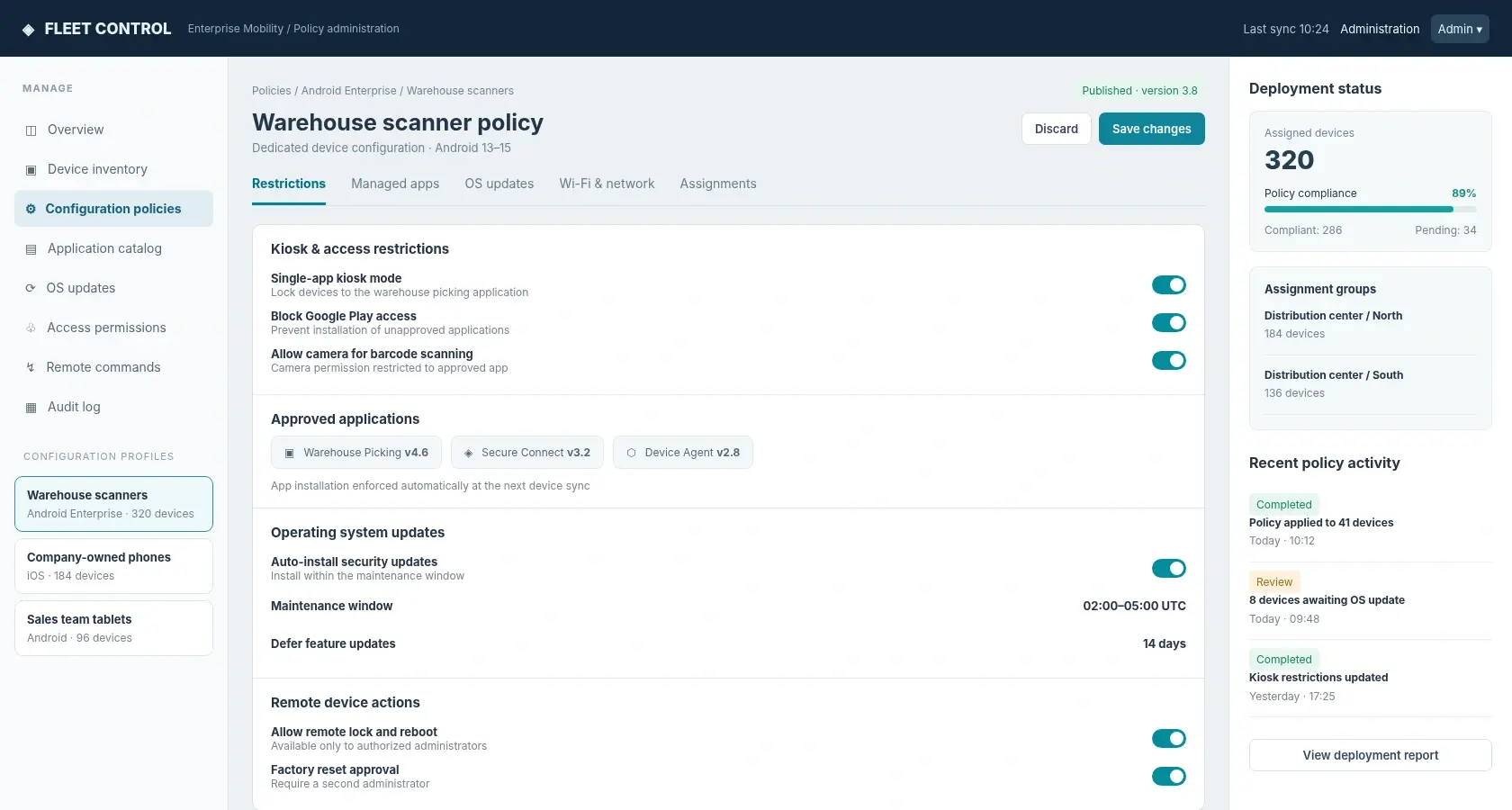
~p~The frontend work included new screens for device management, updates to forms and configuration workflows, and modernization of the component library.
~3~User access service
~p~Backend work focused on a service responsible for user permissions. Engineers revised data storage and request-processing logic and improved interactions with the platform’s data stores and messaging components.
~3~Incremental modernization
~p~Older parts of the product were replaced in stages rather than through a complete rewrite, allowing existing workflows to remain available.
~3~Automated quality checks
~p~UI scenarios checked administrative actions, while API tests verified backend requests and communication between components. These checks were incorporated into the development workflow to catch regressions earlier.
~2~Engineering Details
~3~Modernization inside an active product
~p~The client's platform was already used to control corporate phones, tablets and data-collection terminals. It supported policies for applications, operating system updates, permissions and remote device actions. Replacing its administration interface or backend wholesale would have interrupted those routines, so engineers upgraded individual components and services while the product continued to evolve.
~3~A separate service for permissions
~p~Backend work concentrated on the user access service, including request-handling logic, data organization and message processing. The service interacts with Redis, PostgreSQL, ClickHouse and a message broker. That mix required attention to how access state and related data are exchanged across platform components, not just to the appearance of the settings pages.
~3~Repeatable UI and API validation
~p~As more controls appeared in the admin interface, repeated manual checks became a release bottleneck. Automated UI scenarios now reproduce actions such as navigating sections, editing configurations, filtering records and saving settings. Backend tests built with Pytest validate API requests and communication between services. This gives the product team earlier feedback when a change breaks an established administration flow.
~3~Implementation specifics
~p~Work was split across the administration interface, the backend access-control service and automated UI/API testing.
~p~New modules and component-library changes were introduced incrementally because device and corporate-policy management had to remain available throughout development.
~2~The Outcome
~p~The vendor's product team gained additional engineering capacity across administration screens, permissions services and testing. The platform could continue evolving while legacy areas were modernized incrementally. Automated UI and API checks reduced repetitive regression work and helped developers detect breakages before release. The project demonstrates long-term product development within the client's team.
Хотите реализовать похожий проект? Расскажите о своей задаче, и мы обсудим возможное решение