~2~Overview
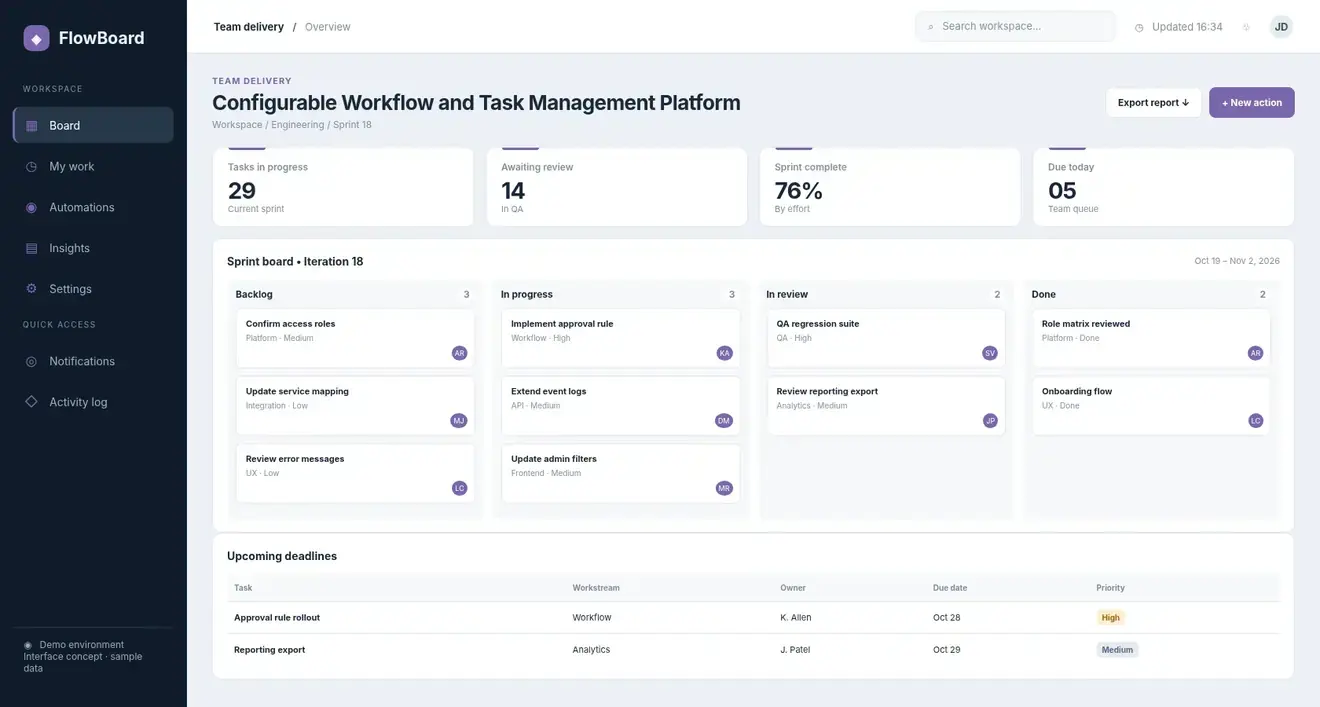
~p~A software provider was developing a configurable platform for teams with different task and workflow requirements. Rather than forcing every department into the same task model, the product needed to support different entity types, relationships and access rules. Engineers joined the client’s development team to work on these foundational capabilities.
~2~The Challenge
~p~A configurable workflow system is more complex than a fixed task board. Administrators need to define what an item represents, which fields and relationships it contains, where it is available and which users can manage it. The product also required consistent interfaces and API support for those configurations.
~2~Solution and Implementation
~3~Flexible workspaces and entities
~p~The team developed configuration capabilities for workspaces and reusable entity types, allowing task-like items to represent different operational records.
~3~Workflow definitions
~p~Configuration files could be used to describe selected workspace and entity rules, supporting adjustments without rebuilding every workflow from scratch.
~3~Relations and permissions
~p~Engineering work covered relationships between items, role settings, board configuration and access to entity types within specific workspaces.
~3~Product interface modernization
~p~The frontend was moved toward the client’s design system, and developers implemented new views, filters and API endpoints to support product features.
~2~Engineering Details
~3~Workspaces and entity types as configuration
~p~The product's central abstraction separates a workspace from the record types available inside it. A record might represent a task, defect, test case or another business item. Engineers built mechanisms for updating workspace and entity configurations, importing workflow rules from files and controlling which types are available in each workspace. This gives teams more flexibility than an application with one hard-coded task schema.
~3~Connections, roles and extensibility
~p~The engineering scope included links between records, access settings, boards, filters and participant management. Each new capability needed corresponding API endpoints and UI behavior. Changes were implemented in an existing product codebase, with Java/Spring Boot services and a React/TypeScript frontend, rather than as an isolated prototype.
~3~Aligning with the client's design system
~p~The user interface was migrated from Ant Design toward the client's own component system. This involved adapting forms, filters and configuration screens while preserving the functional relationships between records. The work remains part of an ongoing product development engagement; the engineering team contributes modules within the client's wider roadmap.
~3~Implementation specifics
~p~The product revolves around workspaces and configurable records representing tasks, defects, test cases and other items. Configuration files can define their behaviour.
~p~The engineering stack includes Java 17, Spring Boot, PostgreSQL, React and TypeScript. UI components were migrated from a generic component library to the product’s design system.
~2~The Outcome
~p~The developing task-management product gained configurable workspaces, record types, relations, role settings and workflows. Teams can adapt the structure of their work instead of fitting everything into one predefined task format. The client continues to develop the platform with embedded frontend and backend engineering support; the work described here covers delivered product components, not a claimed market-wide launch.
Хотите реализовать похожий проект? Расскажите о своей задаче, и мы обсудим возможное решение