Overview
A healthcare software provider offered speech-to-text capabilities for clinical documentation. To make the functionality usable within a partner’s existing healthcare information system, the integration had to bridge different interfaces, business rules and legacy components. The engineering work extended beyond connecting two APIs: it included system changes and a dedicated text-editing workflow.
The Challenge
Clinicians needed a practical way to dictate notes and work with the resulting text without manually transferring information between applications. The target healthcare system had legacy components that were not originally designed for the new integration. Several product teams and vendors had to coordinate the changes.
Solution and Implementation
Integration APIs
REST services were developed to connect the speech recognition solution with the healthcare information system and its existing components.
Legacy application updates
The existing clinical software required refactoring and additional functionality so that it could support the new interfaces and workflows.
Medical text editing
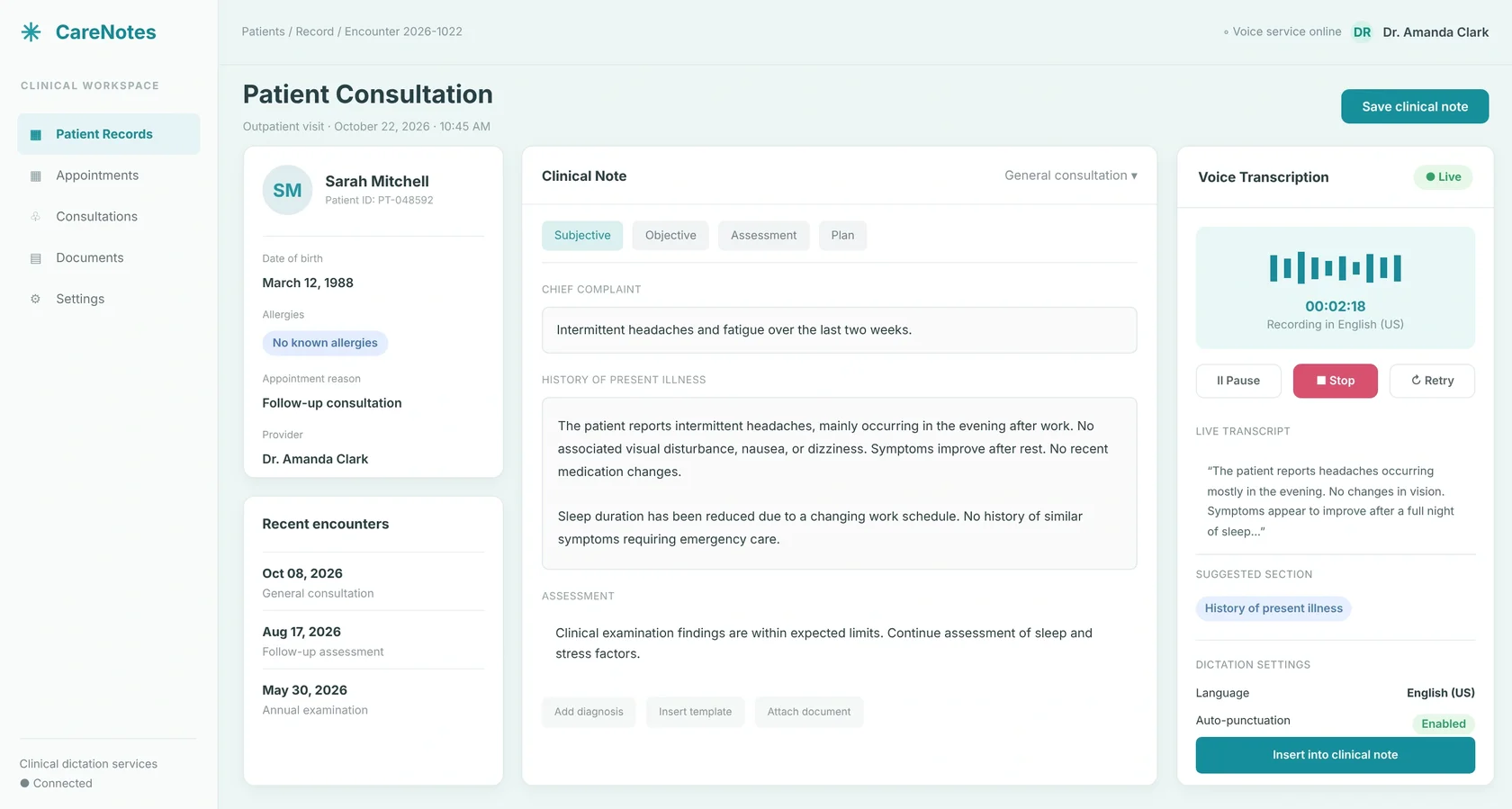
The team developed an editor for reviewing and correcting recognized speech. It supported user-defined terms, abbreviations and substitutions important for domain-specific clinical language.
Cross-vendor coordination
The delivery team coordinated technical requirements and integration work across the systems involved, aligning interfaces with the actual documentation workflow.
Engineering Details
Connecting two established products
The speech-recognition platform already included its own interfaces, license rules and business processes. The receiving medical information system had a separate architecture and older components that were not ready for the integration. The engineering team implemented REST endpoints and adapted the legacy system so speech-derived notes could become part of the clinical documentation workflow.
Editing that reflects clinical language
Automatic transcription is only the first step. Clinicians must correct names and specialist terms, expand abbreviations and turn dictated material into usable notes. The new editor therefore supported configurable vocabularies, abbreviations and replacement rules. Doctors could review recognized text in a purpose-built interface rather than depend on generic text editing alone.
Coordination as part of implementation
The project involved a medical software vendor, a speech technology provider and the healthcare system receiving the integration. Interface changes had to be coordinated across those parties, with existing licensing and operational constraints respected. The work combined API engineering, legacy refactoring, new UI components and cross-vendor integration rather than development of a speech recognition model from scratch.
The Outcome
The project connected an existing speech-recognition product to a healthcare information environment through new REST services, legacy-system changes and a clinical text editor. Physicians gained a workflow for correcting transcripts with medical terminology and personalized abbreviation rules. The work delivered integration and supporting product functionality; its value was making transcription usable inside an established clinical process, not introducing a separate dictation application.
Technologies and Engineering Capabilities
REST APIs, legacy healthcare-system refactoring, third-party speech-to-text integration, clinical text editor and configurable medical dictionaries.